'We're arriving, señor,' said the helicopter pilot. 'It's down there, by that hill. I'll land as close as I can get. Time is going to be crucial.' The helicopter dropped down vertically and bounced once before finally settling on the grassy slope.
There were a number of people gathered about fifty metres further up the hill, and several vehicles: cars, police vehicles, two ambulances and a fire engine. It was otherwise a lonely spot, close to a country road; pleasant with green grass, trees and four or five wooden tables with benches for picnickers.
New Year is part of the Christmas holiday season in Spain, and in Andalusia, where the weather is often mild at this time of year, families will often head for the nearest countryside with a picnic basket and spend an afternoon in the fresh, clean outdoors.
The helicopter pilot jumped out and pulled open the side exit for me, and I jumped out immediately with my backpack and heavy canvas bag. I was not alone. Sunny, my 4-year-old golden retriever leapt out too, thankful to be out of that strange and noisy craft. However, I had another companion with a more complex name: High Degree of Articulated Freedom Robot. Naturally, you cannot use that name all the time when talking to an AI robot, so I had given her a shorter name - Heidi.
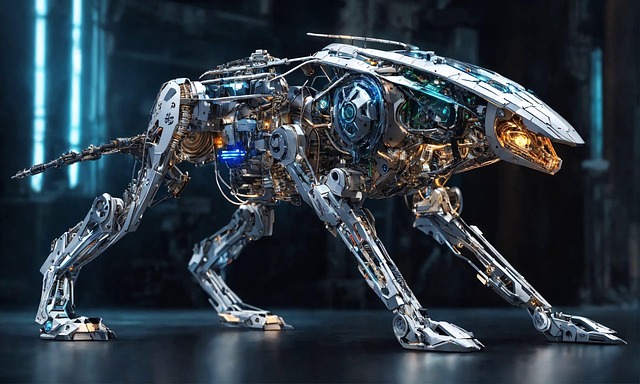
At my robotics company in Almeria, she had been my own creation, although a whole team of computer engineers had been responsible for her construction. Although smaller than a golden retriever, she looked like a dog in shape, so much so that Sunny, the golden retriever accepted her company even though a little suspiciously.
However, there was little covering the shiny, titanium structure, so she looked something like a yellow and silver dog skeleton. But she had two, bright, green and gold-coloured eyes, and there was a hook-like hand at the end of the tail - so she could hold firmly to any surface. She behaved like a dog too - the perfect companion: all obeying, fast and responsive with a strength far exceeding her canine friend, Sunny.
The three of us ran up to the large group of people gathered around the hole. I was aware there were television cameras on me, reporters with microphones wanting an exclusive. I ignored them, and they seemed to respect that. There was something that needed doing, and fast. However, all eyes were then on Heidi; nobody had seen anything like her before.
I was the first to speak.
'My name is Mike Finnigan, from Cyber Robotics. I've come to help. Who are the parents?' I asked in English as my Spanish was bad. A slim, dark-haired man stepped forward with his wife just behind. Their faces were full of worry, they had obviously been crying. He spoke in an English with a strong accent.
'I am the father. My name is Juan Fernandez. What do you want to know?'
'How long ago did your son fall into the hole?'
'That was about 11 o'clock this morning. It is now one o'clock.'
'Two hours. How old is he?'
'Carlitos is two and a half.'
I looked at the hole. It was what is called a borehole, an attempt at locating deep underground water for watering crops. This one was illegal. Unfortunately, the fool of the farmer who owned it had failed to block the entrance - and so close to a picnic site too. The problem was its width - only about 25 cm wide, no adult human could possibly be lowered down on a rope to pull the child up - they simply would not fit. Furthermore, the borehole was over 100 metres deep!
'Do you know if he fell head first or feet first?'
'I think feet first. I just saw him as he fell. He cried out.'
'Has there been any sound from the hole since?'
Juan Fernandez cupped his face in his hands and sobbed.
A large man stepped forward in fire brigade clothing.
'My name is Pedro. I'm in charge of the operation.' His English was also excellent. 'The father told me that after about five minutes his son, Carlitos, stopped crying and fell silent.'
So he didn't die on impact I thought to myself. He might have just passed out.
'How far down do you think he is?'
'We shone powerful torches down there and could see nothing. Then we lowered a camera down. We saw a bag of sweets, then earth at about 70 metres down. He's under that earth, señor Finnigan.'
That was too much for the mother. All of a sudden, she rushed forwards towards me.
'Can you do anything? Nobody knows what to do. We're helpless. Can you get my son out?' She looked down at Heidi and her metal frame reflecting the afternoon sunlight. Other eyes looked down too on this bizarre metallic thing and suspected what it was for.
'I'm going to try. I can't promise anything. This is Heidi. She's, er, it's a robot. I believe it can rescue your son. Do I have your permission to try, señora?'
'Of course, of course, but please be quick!'
I hurriedly set up the equipment from out of my bags.
'Can I help, señor?' Pedro stepped forwards.
'Please. Undo these two ropes. One has a harness and the other is fixed to this small sack, while I set up the laptop and monitor.'
I then had to think fast. After I had the computer equipment ready, I knelt down at the side of the borehole and felt the walls. Cement.
'Pedro. Are the walls cement all the way down to the bottom? I imagine they're not.'
'These holes are dug with a machine and lower down the walls are just earth.'
So as the child fell, his body brushed against the sides of the hole bringing the earth down on top of him, I thought to myself. Not good.
I turned to Heidi. I had already typed in the programme for her to follow.
'Go, Heidi!'
She almost jumped into the hole head first. Even her small body would find it difficult to descend, but she disappeared rapidly into the darkness. Unlike the slow and clumsy articulated robots we usually see, those constructed at my company had the ability to react and move with lively and precise movements.
I looked into the borehole, as did Pedro and the father. I could see Heidi's multiple phosphorescent bulbs on her titanium frame had now lit up. The brightness descended as her feet dug expertly but carefully into the walls of the borehole so as not to disturb the soft soil.
I then turned to the laptop screen and monitor, and Pedro and the father followed. I examined the screen. There was now a crowd of people behind us, silent but impatient. The camera and microphone on Heidi's tail showed her metal frame moving mechanically down metre after metre.
'There's the bag of sweets,' said Pedro pointing at the screen. 'And there's the earth. The tunnel stops there.'
Heidi did not pause. She began digging with great care into the floor. We could hear the sounds over the speakers.
I then picked up the rope with the sack and dropped it into the hole, ensuring that for the last few metres they were lowered slowly.
Heidi now had two feet fixed firmly into the tunnel walls, the camera and microphone on its tail, while the remaining two feet pushed the soft soil into the bag. People crowding behind the monitor, watching, waiting, hardly daring to breathe.
Then it happened. The rest of the earth on the tunnel floor then dropped down showing the head of a small boy.
'Raise the bag of earth, Pedro. Don't let it drop down onto the child!' I shouted.
While Pedro rapidly pulled up seventy metres of rope, I lowered the other rope with the harness.
It was a matter of a few tense minutes, but eventually the harness appeared on the monitor screen. Yet at that moment, something truly amazing was taking place.
During the wait, Heidi had attached a small mask to the boy's face, and a tube then led to a tiny bottle of oxygen visible inside Heidi's frame. The body moved and everybody clearly heard a small cry.
'He's alive!' shouted the father. 'Carlitos is alive!'
'The boy was covered by earth above, but below there must have been an air space so that he could continue to breathe,' I suggested.
We could now clearly see Heidi expertly attaching it to the child's body. Heidi paused. She had no voice but sent a message that appeared on the screen: Pull him up carefully!
Pedro and I both pulled up the rope, and we could see Heidi below the boy holding his legs with her two feet so the body would not come into contact with the tunnel walls and cause another fall of earth.
The boy cried again, and despite this desperate sound - because this meant the boy was alive, people started cheering behind me.
Then Carlitos appeared at the hole entrance with Heidi close behind. An ambulance medic picked him up in her arms.
'I think he's going to be OK,' I understood her to say in Spanish as the mother stroked away the warm tears on his cheeks. 'He is suffering from hypothermia. We'll take him to hospital straight away. The parents can come with us in the ambulance.'
The mother came up to me before she left, and held my two hands in hers. 'Thank you. You are a good man. Thank you so much for everything you have done here.'
'I couldn't have done it without Heidi,' I answered.
We both looked down, but Heidi had collapsed on the ground at my feet, her batteries exhausted, but Sunny, my golden retriever, was looking up at us hoping for some affection. The mother bent down and stroked her head.
'I must go,' she said, and began to walk towards the waiting ambulance.
'Happy New Year!' I called after her.
'Incredible machine you have there, Mr Finnigan.' It was Pedro, the firefighter.
'Thanks,' I answered. 'It did its job today. I developed it as a rescue dog robot to save people buried under collapsed buildings after an earthquake.'
'You must sell a lot of them!'
'Not so. I haven't sold any, Pedro! Buying an expensive robot like this is not profitable. It seems I'm just a dreamer!'
'Nevertheless,' said Pedro. 'You designed and built one at your expense. We are grateful to people like you, Mr Finnigan.'
Copyright © 2026 Practising English
All rights reserved